AI Good and Bad


AI .. open source and open weights .. good news and good for competition.

My guess MORE US companies will look at possible self hosting options if OpenAI and Anthropic keep charging so much
 
David Sacks

The All-In Podcast

@DavidSacks

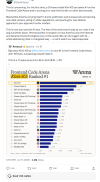
This is concerning. For the first time, a Chinese model Kimi K3 has taken #1 on the Frontend Code Arena and is scoring at or near the frontier on other benchmarks. Meanwhile America is tying itself in knots: politicians and bureaucrats are banning new data centers, piling on state regulations, and pushing for new federal agencies to pre-approve frontier models. This is how you lose the AI race. The rest of the world won’t play by our rules if we bog ourselves down. Permissionless innovation is how America won the internet and became the technological envy of the world. We can do it again with AI -- while addressing risks in a targeted way -- or we’ll watch our lead evaporate.


1784449591498.png


1784449659577.png
 
  • Like
Reactions: wrapter
I’m not so sure I want us to win this race….

I keep hearing and reading that it’s the most important thing since toilet paper, but I’ve yet to read a simple explanation of exactly why and how other than putting people out of work, high costs, dubious performance in real world work, guardrails, making people intellectually lazier than they already are ..

I’m just not ready to hand my medical decisions, money decisions, legal decisions, etc over to technology that has proven thus far to be prone to lying, hallucinations, and costs beyond reality

It does make some killer Memes though..

 
One of hundreds of examples that AI is just another tool to be used how humans want it to be used...

When they control the AI, and you depend on it for honest answers ...... well, you lose


  • Haha
  • Like
Reactions: mat200 and wrapter
I guess AI will eliminate the need to leave your house/port/city…?

 
  • Exclamation
Reactions: mat200
One of hundreds of examples that AI is just another tool to be used how humans want it to be used...

When they control the AI, and you depend on it for honest answers ...... well, you lose
When it comes to historical facts or version of events, Geopolitical answers, AI is going to lie.

But for everyday use it's going to help a lot. In some 2 to 5 years time, even a opensource LLM running locally will be vastly superior to any frontier model.
 
  • Like
Reactions: johnfitz
I think for some things probably.
But it will be a long time before I trust it to make my medical decisions, legal, money management etc

Now if you could teach it to paint my storm shutters like I’m doing the past 2 days in 90 degree heat, I might change my mind!
 

Here's the paper ...


and here's MS AI executive summary :

Executive Summary — The AI Layoff Trap

Firms adopting AI face a structural economic trap: each company captures the full cost savings from automating jobs but only a fraction of the demand loss caused when displaced workers reduce spending. Because the remaining demand loss falls on rival firms, competition pushes every firm to automate more than is collectively optimal. Even with perfect foresight, rational firms cannot escape this dynamic.

Core Insight Automation creates a demand externality: when workers lose income, aggregate consumer demand falls. Individual firms internalize only a small share of this decline, so they continue automating even though the collective result reduces profits for all firms and harms workers. This is not a redistribution problem—it is a true deadweight loss.


Key Findings​

1. Competitive markets over-automate by design

  • Each firm’s dominant strategy is to automate more than the socially optimal level.
  • The gap between private incentives and collective welfare widens as the number of competing firms increases.
  • In the frictionless case (no integration cost), the model becomes a Prisoner’s Dilemma: all firms automate fully even when it reduces everyone’s profits.
2. Better AI makes the problem worse

  • Higher AI productivity increases the incentive to automate beyond rivals.
  • At equilibrium, these competitive gains cancel out, leaving only deeper demand destruction.
3. Standard policy proposals don’t fix the externality The paper evaluates six interventions and finds that most fail to correct the core distortion:

  • Upskilling / retraining: Helps only if displaced workers fully regain income (η = 1). Rare in practice.
  • Universal Basic Income: Raises baseline demand but does not change automation incentives.
  • Capital income taxes: Scale profits but do not affect marginal automation decisions.
  • Worker equity: Recycles some profits back into demand but cannot fully close the wedge unless profit-sharing exceeds 100% (impossible when λ < 1).
  • Coasean bargaining: Fails because automation is a dominant strategy and automation choices are not contractible across firms.
4. Only a Pigouvian automation tax works

  • A per-task tax equal to the uninternalized demand loss aligns private incentives with the social optimum.
  • Revenue can fund retraining, which increases income replacement (η) and gradually shrinks the externality.
  • As η rises, the required tax falls—potentially becoming self-limiting.

Strategic Implications​

For policymakers:

  • Focus on preventing excessive automation, not just mitigating its aftermath.
  • A Pigouvian automation tax is the only instrument that directly targets the competitive distortion.
  • Pair the tax with retraining investments to raise long-term worker income and reduce future tax needs.
For firms:

  • Recognize that individually rational automation choices may collectively erode the customer base.
  • Industry-wide restraint cannot be sustained voluntarily; policy intervention is required.
For economists and regulators:

  • The model reframes AI displacement as a product-market failure, not just a labor-market issue.
  • The externality persists even with perfect foresight, complete credit markets, and high AI productivity.